
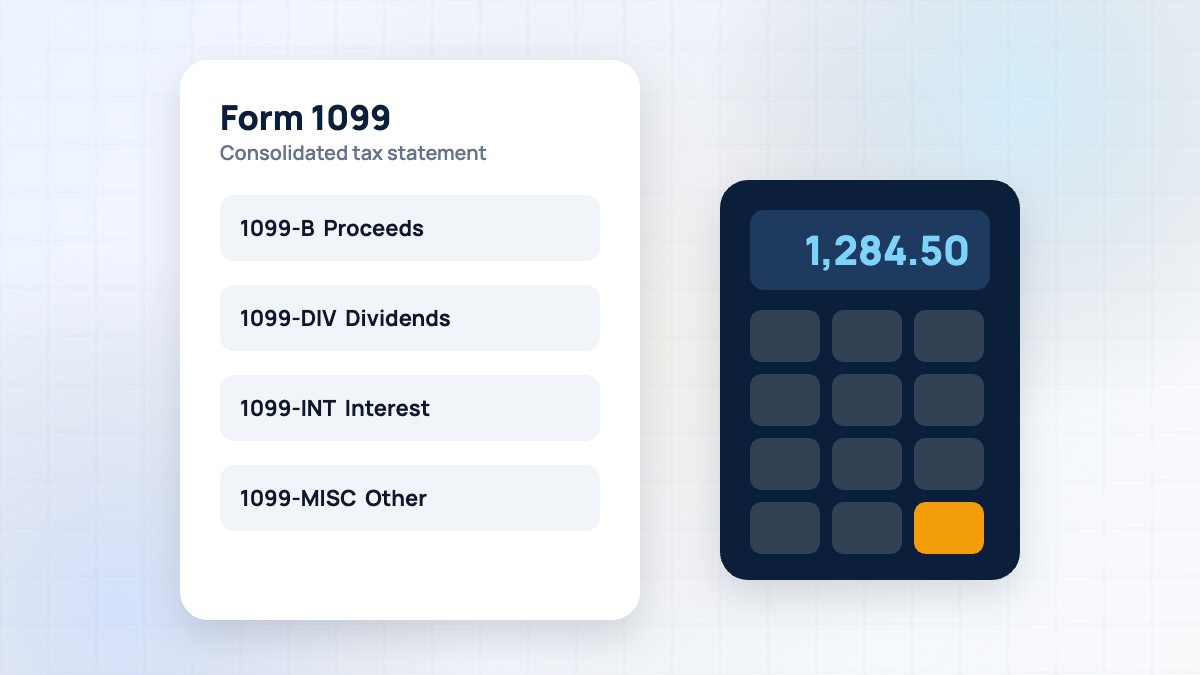
Quick answer: Robinhood sends a consolidated Form 1099 for taxable brokerage accounts that combines 1099-B (sales of stocks, ETFs and options), 1099-DIV (dividends), 1099-INT (interest) and 1099-MISC (bonuses and other income) when they apply. Crypto activity is reported on separate forms, including the newer 1099-DA for digital assets. Forms are usually available in the app around mid-February, and corrected forms can follow. You owe tax on gains when you sell, plus dividends and interest — not on investments you still hold. IRAs get different forms.
Taxes are where many new investors get surprised. This guide explains the forms, timing and basics. It isn’t tax advice — consider a tax professional for your situation.
Which Robinhood tax forms you may get
| Form | What it reports |
|---|---|
| 1099-B | Proceeds, cost basis and gains/losses from sales of stocks, ETFs and options |
| 1099-DIV | Dividends and capital gain distributions |
| 1099-INT | Interest, such as on uninvested cash |
| 1099-MISC | Other income, such as some bonuses, rewards or stock lending payments |
| 1099-DA / crypto forms | Sales and other disposals of digital assets |
| 1099-R | IRA distributions |
| Form 5498 | IRA contributions (informational) |
When Robinhood tax forms are released
Brokers must send most 1099 forms by mid-February. Robinhood typically makes consolidated forms available in the app under Account → Tax center/Documents around that time, and notifies you by email. Some accounts receive forms later if they hold securities that issue late tax information. Corrected 1099s can arrive in March or later when companies reclassify dividends. If you file very early and a correction arrives, you may need to amend your return, so many investors wait until early March.
How investment taxes work (the basics)
| Event | Taxed? | Notes |
|---|---|---|
| Buying stock | No | Sets your cost basis |
| Holding stock | No | Unrealised gains aren’t taxed |
| Selling at a gain | Yes | Capital gains tax |
| Selling at a loss | Deductible | Can offset gains and up to $3,000 of income per year |
| Dividends | Yes | Qualified dividends may get lower rates |
| Interest on cash | Yes | Ordinary income |
| Trades inside an IRA | No | Taxed only on certain withdrawals |
Short-term vs long-term gains
Short-term gains come from investments held one year or less and are taxed at your ordinary income tax rate. Long-term gains come from investments held more than a year and get lower rates (0%, 15% or 20% for most people, depending on income). This is why frequent trading can lead to higher tax bills than long-term investing. Your 1099-B separates short-term and long-term sales. The IRS capital gains topic explains the rules.
Wash sales
If you sell at a loss and buy the same or a substantially identical investment within 30 days before or after, the loss is “washed” — it can’t be claimed now and is added to the cost basis of the new shares. Robinhood’s 1099-B reports wash sales it detects in the same account. Active traders should watch for this, especially around year-end.
Options taxes
Options profits and losses are usually treated as capital gains. Holding period depends on how long you held the option. If an option expires worthless, you generally have a loss equal to the premium paid. If you exercise, the premium usually adjusts the cost basis of the shares. Some index options receive special tax treatment (60% long-term, 40% short-term) under section 1256. Options taxes can get complex — keep records and consider professional help. See our options guide.
Crypto taxes
Crypto is treated as property. Selling for cash, swapping one coin for another or spending crypto can create gains or losses. Brokers now issue Form 1099-DA for digital assets, starting with transactions from 2025. If you transferred coins in from elsewhere, Robinhood may not know your original cost basis, so keep your own records. See the IRS digital assets page and our crypto guide.
Dividends and interest
Dividends from stocks and ETFs are reported on 1099-DIV. Qualified dividends (from most US companies held long enough) are taxed at long-term capital gains rates; others are taxed as ordinary income. Interest from uninvested cash, including Gold’s higher APY, appears on 1099-INT and is taxed as ordinary income. Reinvested dividends are still taxable in the year they’re paid.
Bonuses, rewards and other income
Free stock rewards, some transfer bonuses and stock lending income may be reported on 1099-MISC. Generally, the value of a free stock when received is income and becomes your cost basis. Credit card cash back is usually treated as a rebate rather than income. Check each form and keep notes.
IRA tax forms
IRA activity doesn’t appear on the consolidated 1099. Instead, you may receive Form 5498 (contributions, usually by May) and Form 1099-R (distributions). Trades inside an IRA aren’t taxed. Withdrawals from a traditional IRA are generally taxable; qualified Roth withdrawals are tax-free. Early withdrawals may add a 10% penalty. See our IRA match guide.
Prediction markets and futures
Event contracts and futures have their own tax rules, and reporting can differ from stocks. Futures are typically section 1256 contracts with 60/40 treatment. Treatment of event contracts is less settled. Keep detailed records and look for specific forms in your tax center.
How to download your Robinhood tax documents
- Open the app and go to Account.
- Tap Tax center (or Documents → Tax documents).
- Choose the year and download the PDF or CSV.
- On the web, use the same path at robinhood.com for easier downloads.
Many tax software programs let you import Robinhood forms directly, which saves typing hundreds of trades.
Tips to reduce tax headaches
- Hold investments more than a year when it fits your plan.
- Use tax-advantaged accounts such as IRAs.
- Harvest losses carefully, avoiding wash sales.
- Keep records of crypto transfers and cost basis.
- Wait for corrected forms before filing if you have many dividends.
- Set money aside for taxes when you take big gains.
A real-world example
Emma sold some stocks in 2026 for a $3,000 short-term gain, received $400 in dividends and earned $150 in interest on cash. In February she downloaded her consolidated 1099 from Robinhood’s tax center and imported it into her tax software. The software calculated tax on the gain at her ordinary rate, applied lower rates to her qualified dividends and added the interest. She also noticed a wash sale adjustment from a stock she’d sold and rebought — which explained why one loss wasn’t deductible.
State taxes
Most states tax investment income too, though a few have no income tax. Your state return usually uses the same 1099 information.
FAQ
When does Robinhood send 1099 forms?
Usually by mid-February, with some forms possibly later and corrections afterwards.
Do I pay taxes if I didn’t sell anything?
You may still owe tax on dividends and interest, even without selling.
Do I pay taxes on my IRA trades?
Not on trades inside the IRA; taxes apply on certain withdrawals.
Why didn’t I get a 1099?
If your activity was below reporting thresholds, you might not receive one — you still must report income.
Can I import Robinhood forms into tax software?
Many tax programs support importing or uploading Robinhood’s forms.
RobinhoodTradeApp Guide is an independent website and is not affiliated with, endorsed by or sponsored by Robinhood Markets, Inc. This article is for educational purposes only and is not financial, investment or tax advice. Fees, rates and features change often, so always confirm details on Robinhood’s official website. Investing involves risk, including the possible loss of principal.


Leave a Reply