Quick answer: Robinhood charges $0 commission to trade US stocks, ETFs and standard options, and there’s no account minimum or monthly fee for a standard account. But some things cost money: regulatory fees on certain sells and options, contract fees on index options, the spread on crypto, Robinhood Gold ($5/month or $50/year), margin interest, instant withdrawals (1.75%, $1 minimum, $150 maximum), outgoing wires and transferring your account out to another broker. Always check Robinhood’s official fee schedule for current amounts.
“Commission-free” doesn’t mean “cost-free”. This guide shows every common Robinhood fee in one place so there are no surprises.
Robinhood fees at a glance
| Item | Cost |
|---|---|
| Stock and ETF trades | $0 commission |
| Standard options trades | $0 commission (regulatory fees apply) |
| Index options | Per-contract fee (lower with Gold) |
| Crypto | $0 commission; cost built into the spread |
| Account minimum / maintenance | $0 |
| Robinhood Gold | $5 per month or $50 per year |
| Standard bank deposits and withdrawals | Free |
| Instant withdrawal | 1.75% (min $1, max $150) |
| Outgoing domestic wire | $25 |
| Account transfer out (ACATS) | Fee applies — commonly $100; check current schedule |
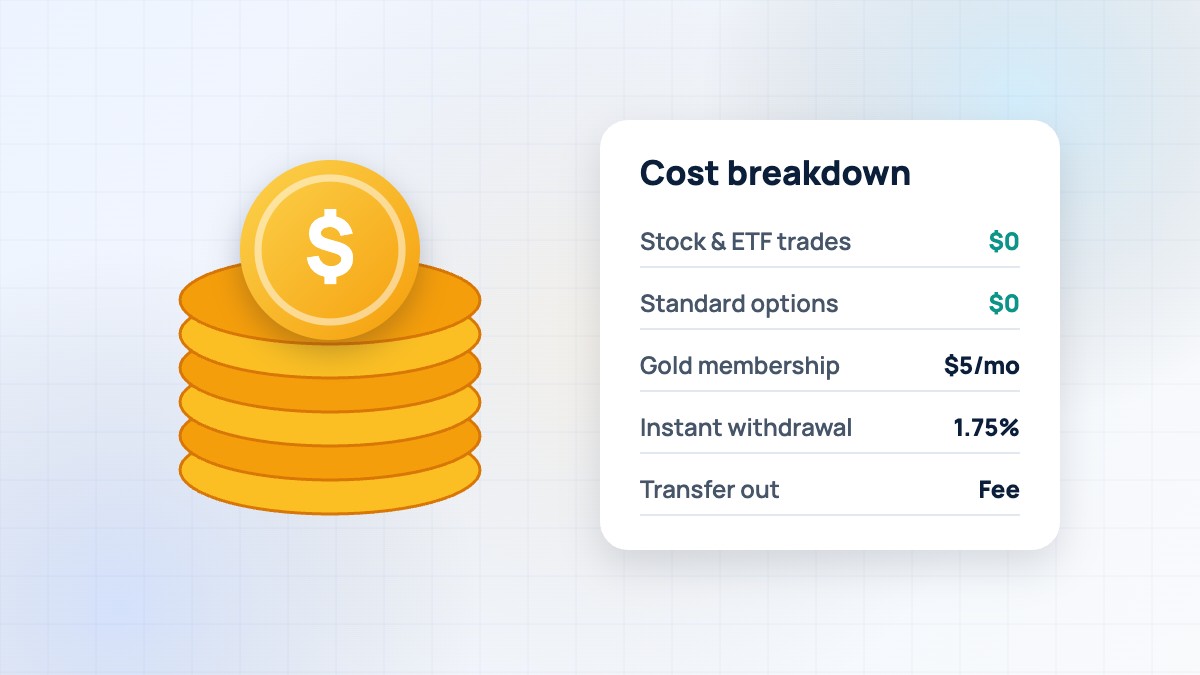
Source: Robinhood’s official fee schedule. Amounts can change.
Does Robinhood charge to sell, deposit or buy crypto?
| Question | Short answer |
|---|---|
| Fees to sell stocks? | $0 commission, but small regulatory fees can apply when you sell |
| Fees to deposit money? | Standard bank (ACH) deposits are free |
| Fees to withdraw? | Standard bank withdrawals are free. Instant withdrawals cost 1.75% (min $1, max $150) |
| Wire transfer fee? | $25 for an outgoing domestic wire |
| Fees for crypto? | No commission, but Robinhood earns from the spread |
Amounts can change, so confirm them in Robinhood’s official fee schedule.
Trading fees
Stocks and ETFs
Buying and selling US-listed stocks and ETFs costs $0 in commission. When you sell, small regulatory fees may apply, such as the SEC fee and FINRA’s trading activity fee. These are usually cents or less on typical trades and appear on your trade confirmation.
Options
Standard equity options have no commission, but per-contract regulatory fees apply on trades. Index options carry a per-contract fee that is lower for Robinhood Gold members. Exercise and assignment are generally free, but check the current schedule. Learn more in our trading guides.
Crypto
Robinhood doesn’t charge a commission on crypto trades, but it earns money from the spread — the difference between the price you pay and the market price. Spreads vary by coin and market conditions. Compare the quoted price before you trade.
Newer products and their costs
| Product | Typical cost |
|---|---|
| Prediction markets (event contracts) | Commission of up to $0.01 per contract (lower with Gold) plus an exchange fee |
| Futures | Per-contract commission plus exchange and regulatory fees |
| Short selling | Borrow fees plus margin interest |
| Robinhood Strategies (managed portfolios) | 0.25% per year, capped at $250 a year for Gold members |
Fees for these products change more often than stock fees, so confirm in the app before trading.
Robinhood Gold
Robinhood Gold costs $5 per month or $50 per year. It adds benefits such as a higher interest rate on uninvested cash (3.6% APY as of September 2026), a bigger IRA match (3% instead of 1%), lower margin rates with the first $1,000 of margin interest-free, research reports, Level II market data, larger instant deposits and access to some premium products. Whether Gold is worth it depends on how much cash you hold and whether you contribute to an IRA. Rates change at Robinhood’s discretion. See our Fees & Gold guides.
Margin interest
If you borrow on margin, you pay interest on the amount borrowed. Rates are tiered by balance and are lower for Gold members. Margin increases both potential gains and losses and can lead to margin calls. Only use it if you fully understand the risks.
Money movement fees
| Transfer | Cost | Speed |
|---|---|---|
| Bank deposit (ACH) | Free | Usually a few business days; instant access may apply |
| Standard withdrawal (ACH) | Free | Usually a few business days |
| Instant withdrawal to debit card | 1.75% (min $1, max $150) | Minutes, if eligible |
| Outgoing domestic wire | $25 | Usually same or next business day |
| Incoming wire | Check schedule | Varies |
Account transfer fees
Moving your investments into Robinhood from another broker is free on Robinhood’s side, and Robinhood often runs transfer bonus promotions. Moving out of Robinhood to another broker through ACATS carries a fee, widely reported as $100 for full or partial transfers. Some receiving brokers reimburse transfer fees — ask them before you move.
Other fees to know
- Paper statements and confirmations: may carry a fee; electronic documents are free.
- ADR fees: some foreign company stocks (ADRs) charge custody fees passed through to holders.
- Reorganisation fees: certain corporate actions may have fees.
- Returned deposits: a failed or reversed bank deposit can lead to fees and account restrictions.
- Foreign transaction fees: depend on the card product you use.
How Robinhood earns money without commissions
Robinhood earns revenue from payment for order flow (market makers pay to execute customer orders), net interest on cash and margin, Robinhood Gold subscriptions, crypto and event contract trading, card products and other services. These are disclosed in Robinhood’s public filings and customer agreements.
How to keep your costs low
- Use free standard bank transfers instead of instant withdrawals when you can wait.
- Avoid margin unless you understand and accept the interest and risks.
- Compare crypto prices before trading, as spreads vary.
- Decide whether Gold pays for itself based on your cash balance and IRA contributions.
- Ask a new broker to reimburse transfer-out fees if you leave.
- Choose electronic statements.
- Use limit orders to control execution prices.
Robinhood fees compared with other brokers
| Robinhood | Typical large online brokers | |
|---|---|---|
| Stock and ETF commissions | $0 | $0 |
| Options per-contract fee | $0 on standard options | Often around $0.50–$0.65 per contract |
| Account minimum | $0 | Usually $0 |
| Transfer-out fee | Yes | Often similar |
| Paid premium tier | Gold, optional | Varies |
Robinhood is especially cheap for options traders because standard options have no per-contract commission. For long-term investors, costs are similar to other major brokers. Detailed comparisons are in our comparisons section.
A real-world example
Jordan trades a few stocks each month, holds $5,000 in cash and contributes $7,500 a year to an IRA. Without Gold he pays no commissions and earns the standard cash rate. With Gold ($50 a year), he would earn a higher APY on his cash and a 3% IRA match ($225 instead of $75 on a full contribution, subject to conditions). For Jordan, Gold more than pays for itself. For a user with $200 in cash and no IRA, it probably wouldn’t.
Where to find official fee information
Robinhood publishes its fee schedules and disclosures on its website and in the app under Account → Documents/Disclosures. Your trade confirmations and monthly statements show any fees charged. When in doubt, check the official help centre.
FAQ
Is Robinhood really free?
Trading stocks, ETFs and standard options has no commission, but some services and transactions have fees.
Does Robinhood charge a monthly fee?
Not for a standard account. Robinhood Gold is an optional $5 monthly subscription.
Does Robinhood charge to withdraw money?
Standard bank withdrawals are free; instant withdrawals cost 1.75% (min $1, max $150).
Does Robinhood charge fees for crypto?
There’s no commission, but you pay through the spread between buy and sell prices.
What does it cost to leave Robinhood?
Transferring your account out usually carries a fee. Check the current fee schedule.
Summary
Robinhood is one of the cheapest ways to trade stocks, ETFs and options, with no commissions and no minimums. The costs that matter most are optional: Gold, margin, instant withdrawals, wires and leaving the platform. Know these in advance and you can use Robinhood at very low cost. This guide is educational and not financial advice.
RobinhoodTradeApp Guide is an independent website and is not affiliated with, endorsed by or sponsored by Robinhood Markets, Inc. This article is for educational purposes only and is not financial, investment or tax advice. Fees, rates and features change often, so always confirm details on Robinhood’s official website. Investing involves risk, including the possible loss of principal.

Leave a Reply